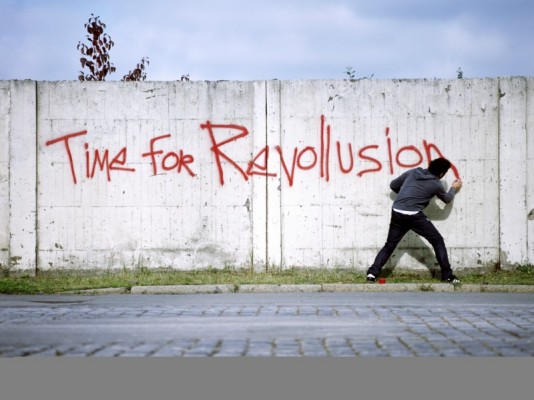
Ein Aktivist aus Istanbul sprayt an eine Wand "Zeit für Revolution" - Recht hat er!
Auf der letzten internationalen Konferenz der kommunistischen Jugendorganisation REVOLUTION wurde im vergangenen Jahr ein neues revolutionäres internationalistisches Programm angenommen, das im Mai in gedruckter Form in Deutschland erscheint. Der Grund warum wir von REVOLUTION uns entschieden, unser altes Manifest mit dem Namen „Road to Revolution“ durch ein neues Programm zu ersetzen, liegt nicht darin, dass wir glauben das es falsch war. Vielmehr haben sich mit der aktuellen Krise des Kapitalismus die konkreten Bedingungen, Möglichkeiten und Gefahren geändert. Dem haben wir mit einem aktuellen Programm Rechnung getragen!
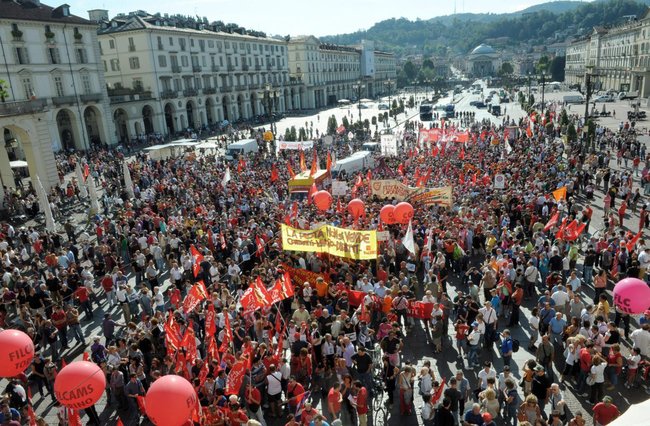
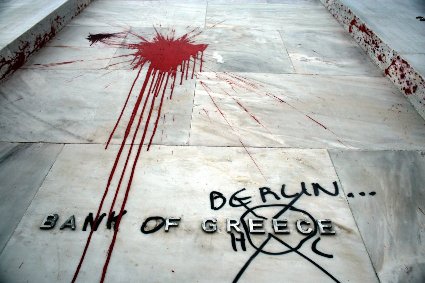
Überall in der Welt brechen Märkte zusammen. In diesem Zusammenhang bereiten oder führen die Herrschenden dieser Welt riesige soziale Angriffe durch, wie wir aktuell in Griechenland sehen können.
Die Kriegsgefahr und das Konfliktpotential nach Außen
nehmen zu, da sich die imperialistischen Staaten
nicht einig sind, wessen Profite gerettet und wessen
vernichtet werden sollen.
Seien es die Aufstände im arabischen Raum, Bewegungen wie Occupy oder die heroischen Auseinandersetzungen des griechischen Proletariats gegen IWF, Troika und das griechische Kapital – sie alle zeigen eines – Widerstand ist möglich! Doch damit Widerstand gegen die Kapitalist_innen, die für die Krise, die zunehmende Armut und die weltweiten Kriege verantwortlich sind, auch erfolgreich ist, bedarf es einer revolutionären Perspektive. Wir brauchen Taktiken des Klassenkampfes, um die Herrschenden in die Knie zu zwingen.
Oft genug hat sich die Linke versteckt, weil sie Angst hatte zu "verschrecken", genauso oft wurde das eigene Programm verwischt, weil man Angst hatte sonst keinen zuspruch zu finden. Wir glauben, dass gerade die revolutionäre Offenheit das stärkste Mittel der Überzeugung und des Erfolges ist!
Der erste Schritt der deutschen Linken muss es sein sich aus der Isolierung heraus zu bewegen und an die Gewerkschaften, sowie Parteien wie SPD oder Linkspartei die Forderung der gemeinsamen Aktion gegen soziale Kürzungen und Angriffe der Unternehmer zu stellen. Die zweite Aufgabe ist es offen über die eigene Politik mit anderen Organisationen aus der „radikalen Linken“ zu diskutieren – wie eine revolutionäre Perspektive, wie die Taktiken des Klassenkampfes aussehen müssen. Wie man eine Alternative zum sozialen Verrat der politischen Führer von DGB, Linkspartei oder SPD aufzeigen kann. Vor allem müssen wir alle jedoch damit beginnen durch die Aktion an Schule, Uni, im Betrieb oder in unseren Gewerkschaften und das organisieren von (proletarischen) Jugendlichen das Blatt zu wenden – nicht nur von Revolution zu reden, sondern sie im hier und jetzt für sie zu kämpfen!
Wir sind bereit und offen dafür mit allen (Jugend-)Organisationen der deutschen Linken und den Verbänden der Jugendgewerkschaften in die Diskussion darüber zu treten, welches Programm eine Jugendorganisation im Kampf gegen die Krise braucht! Unser neues Programm ist unser grundlegender Beitrag zu dieser Diskussion. Es ist aber auch schon jetzt die gelebte Praxis unserer Organisation.
Kampagne für ein revolutionäres Programm, gegen die Krise!

Revolutionäre Ideen werden nur durch die Tat bewiesen und können dort erfolgreich sein - deswegen wollen wir unsere Vorschläge in der Praxis und in Aktionen zusammen mit den Jugendbewegungen überprüfen!
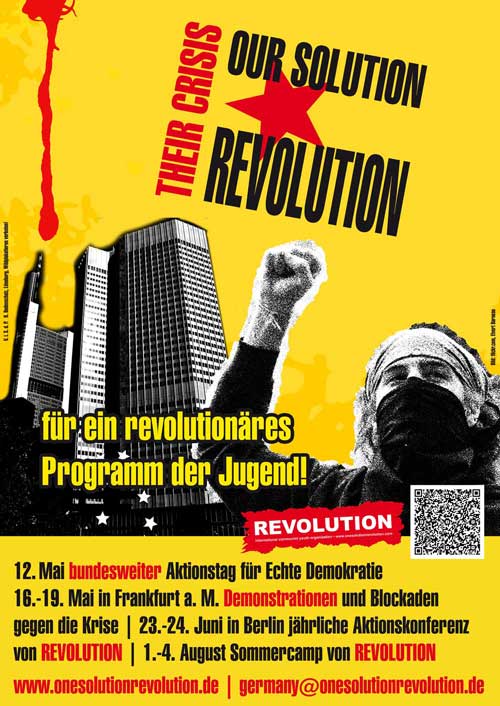
Passend zum ersten Mai beginnen wir daher unsere Kampagne gegen die Krise! In den kommenden Wochen werden wir uns an den Aktionen in ganz Deutschland und vom 16.-19. Mai in Frankfurt beteiligen. Wir werden in unseren Ortsgruppen Öffentlichkeitsarbeit zu den Auswirkungen der Krise auf die Jugend in Deutschland machen und wollen aufzeigen, warum wir nur gemeinsam und solidarisch mit der Jugend Europas und der internationalen Arbeiterbewegung eine Chance im Kampf gegen die Krise und das dahinter stehende System – den Kapitalismus – haben. In diesem Zusammenhang wollen wir auch als internationale Organisation in die Länder Südeuropas fahren und beispielsweise mit griechischen, italienischen oder spanischen Jugendlichen über unser Programm diskutieren.
Wir werden versuchen überall so stark wie möglich zu zeigen, warum wir nur organisiert und mit einem revolutionären Programm siegen können – im Internet, auf der Straße, auf Veranstaltungen, in der Schule, im Betrieb!
Im Juni werden wir daher auch in verschiedenen Teilen Deutschlands Veranstaltungen zu unserem neuen Programm machen, das sich gerade in der Übersetzung in´s Deutsche befindet (und das ihr weiter unten schon auf Englisch lesen könnt). Wenn auch du unseren Aufruf gegen die Krise teilst, dann unterstütze unsere Kampagne, werde aktiv zusammen mit uns, diskutiere mit anderen Genossen der Organisation, in der du vielleicht bist über unser Programm- in Deutschland und International!
Im Juni werden wir dann unsere bundesweite Konferenz vom 23.-24. Juni 2012 in Berlin haben, zu der du dich gerne anmelden kannst, wenn du mit uns aktiv werden willst oder es über die Aktionen im Mai und Juni schon warst!
Interesse an gemeinsamen Aktionen, Diskussionen oder Zusammenarbeit? Dann melde dich an germany@onesolutionrevolution.de oder schreibe uns direkt über unsere Kontaktleiste! Materialien unserer Kampagne – also Sticker, Flyer, Plakate und Programme – schicken wir dir auf Nachfrage gerne zu.
What we stand for
REVOLUTION is an international revolutionary socialist youth organisation.
We aim to overthrow capitalism through a workers’ revolution and replace it with a global socialist society, based on production for need, not for profit. We want to bring about a planned global economy based on democratic councils of the working class and through this create a world without classes, borders, private property, exploitation, oppression, division and war.
The recent crisis of capitalism shows that this system doesn’t provide a future for a large proportion of people living on our planet. On the contrary it is destroying the living conditions for many people by creating unemployment, hunger and an ecological catastrophe. The struggle for socialism is therefore not a distant task but an immediate necessity to replace the destructive reign of capitalism.
While only the working class can bring about a change of the existing system through their economic role in capitalism, we believe youth must play a vital role in this process. In past struggles young people played an important role and have often triggered broader mobilisations and struggles in the workplaces.
At the same time young people face additional forms of oppression. Within society we are often super-exploited, sometimes driven into illegal forms of employment to earn additional money. Within the family young people are subjected to a system of patriarchal rule in which the male head of the family will often not tolerate their rights or permit initiative in their individual development.
When young people take action and express demands they are often not taken seriously or dismissed as an expression of general anger which is understood to be “normal” among youth. REVOLUTION tries to organise this justified anger against a system that bases itself on exploitation and inhuman living conditions in large parts of the world.
Within the struggles this system creates we are putting forward a programme of action that not only shows how we think we can effectively fight individual attacks but also provides a general perspective of self-organisation in order to create a socialist society based on the democratic rule of the working class and the youth. Only with a clear programme of how to connect todays’ struggles with a revolutionary perspective for overcoming this system will we be successful in bringing about the change that millions are hoping for.
Fighting for youth
All across the world,
young people are getting a raw deal. Suffering from the diktat of the family, blamed for the ills of society, yet often suffering the brunt of unemployment, low pay and poor working conditions young people have much to fight for, and much to fight against.
As the capitalist class seeks to reduce spending on services and privatise education, young people are at the sharp end of the recession through high unemployment and a lack of opportunity. A difficult start in early life has long term consequences, and the fight against youth oppression is now more important than ever.
We are fighting to create independent youth unions and an independent, international socialist youth movement to organise the fight for our rights.
We say:
- Eradicate child prostitution. Nationalise the sex industry under democratic control.
- Zero tolerance of child abuse – tough penalties for beatings and cruelty.
- Free, funded universal education, compulsory until the age of 15 and optional thereafter. For a decent living allowance, food and accommodation for all students.
- For the right to work. Tax the rich, build infrastructure and public services with wages that can allow for a decent standard of living as determined by youth and workers’ organisations.
- Provide more jobs by cutting the hours of the overworked with no loss of pay.
- Nationalise criminal employers without compensation, and those companies which refuse to provide decent pay for apprenticeships.
- End the care burden; provide good quality state care for the elderly, ill and disabled.
And:
- Equal pay for equal work –abolish unpaid internships.
- End boredom. For youth centres, parks and the right to free time and a social life.
- Abolish laws against consensual sex. No criminalisation of young people for buying drink or drugs.
- Abolish prison sentences for youth.
- Full citizenship rights at 15, including the right to vote and the right to work.
For a revolutionary youth movement
Everywhere young people are coming to the forefront of resistance. In the Middle East, young people have courageously fought against the repressive police, the militias and the death squads of Mubarak, Ben-Ali and Gadaffi.
Across Europe, from London to Madrid to Rome, students and youth have been the first to take radical action in efforts to defend themselves from the capitalist crisis. Wherever there is oppression and attacks from the ruling class, be it in the killing fields of Sri Lanka or the besieged Gaza Strip, it is the youth who are in the frontline of resistance.
Oppressed and pushed about in the home, denied rights at school, discriminated against at work, sent off to fight and die in capitalist wars, yet denied a vote in elections; subjected to petty rules and harassed by the police, the youth of the world have much to be radical about.
What is more, young people have not been through the same cycle of defeats as the older generations, have weaker material and social ties to the existing order and consequently show huge reserves of idealism and the desire to fight for a future free from poverty and oppression.
And yet, even within progressive movements we are pushed aside and denied a voice. During the movement to stop the war in Iraq, young people walked out of their schools, took direct action, and formed the bulk of the millions of demonstrators who came out to oppose the invasions.
But no organisation had young people on their leadership bodies, few demonstrations had young people speaking on the platforms, and young people’s ideas on how the movement should develop were often roundly ignored by the more ‚experienced‘ older generations.
Young people need an organisation of our own – an organisation that belongs to us and is not under the control of any ‘adult’ party or movement. We need to do it ourselves. Only in this way – by making our own initiatives, learning from our own mistakes and developing our own methods of campaigning, will we be able to bring hundreds of thousands of young people into revolutionary struggle.
REVOLUTION campaigns against every crime of capitalism. We will take joint action with all other progressive movements wherever we share common goals.
But REVOLUTION is more than just an activist group. We also resist the capitalists’ propaganda war. We fight to persuade the majority of working class youth and students that capitalism is not invincible, that the world is ready for fundamental change and that a new communist society is not a utopia but possible and necessary.
Therefore we intervene into every progressive movement which positions itself in opposition to imperialist war, sexism, racism, and austerity. We fight for higher wages, better living conditions and engage with every struggle which brings the needs of the oppressed into conflict with the interests of the ruling class and its governments.
REVOLUTION is an organisation that fights alongside youth, workers, poor farmers and other oppressed groups. In the daily struggles we want to demonstrate the value of our program, the demands we raise and the proposals we make.
Equally we refuse to remain silent over the failures of reformist and bourgeois leaders of the movements we are fighting in. We´ll demonstrate their failure in practice.
The unwillingness of the ‘official’ leaderships to build grassroots movements with real power is the single most important factor in ensuring the struggle never escapes control of the official leaders, the collaborators, who have made their peace with the capitalist class. This prevents struggles for immediate demands being transformed into a fight against the system which caused the crisis itself: capitalism.
This means that we are not just fighting in the movements for limited goals and against the attacks by the capitalists. We want to give these movements a revolutionary perspective. We want to build a revolutionary youth movement!
Above all we are an international group. Just as the capitalists use their international organisations to divide and exploit the world’s people, so we need to co-ordinate our resistance on the world level.
Capitalism in crisis
Capitalism is a failing system. In 2007, this was dramatically exposed to many when an historic crisis hit financial markets across the world. This was the climax of two decades of globalisation under the institutional rule of the WTO and the IMF and free trade agreements like NAFTA.
Every corner of the world was opened up to private profit. But banks across Europe and the USA suddenly found that their immense wealth was based upon debts, which their clients could not repay. In other words, the vast fortunes they supposedly owned didn’t actually exist in the real world.
In times of capitalist expansion profits are accumulated in the hands of a small minority, and in order to preserve their wealth, the bailouts saw their losses socialised. The banks were deemed “too big to fail” and were bailed out to the tune of $ trillions across the world. The money for these bailouts had to be borrowed from the bond-markets (international finance capitalists) and is being repaid by cutting the education, jobs and services that millions of ordinary people rely on.
Despite receiving these massive bail-outs and the fact that many were at least part-owned by their national government, they continued to pay their investors and top staff billions in bonuses, whilst repossessing poor and bankrupt people’s homes, and refusing credit to working people and small businesses.
The course of the crisis clearly showed that vulgar theories believing in a separation of the financial economy and the so-called “real”-economy are doomed to fail the test of practice. As the economies of the world have seized up, millions have lost their jobs as entire sectors of industry have been shut down, and global unemployment and poverty has rocketed.
Across Europe and America, governments have had to borrow billions to make up for lost taxes, pay for further bail-outs and spend on spiralling welfare bills. In places such as Portugal, Ireland, and Spain, government debts have led to the encroachment of the IMF and bail-outs from international investors. In Italy and Greece, the IMF has directly replaced the democratic governments with unelected ‘technocrats’.
As the global recession has developed, national governments have attempted to shield their own capitalists from the effect of the crisis by helping them to profit from the misery of those countries drowning in debt.
The financial crisis therefore developed into a debt crisis as the governments around the world united to save capitalism. This didn’t merely save the big corporations and financial institutions but ushered them into a new speculative frenzy. Big financial institutions were betting on the future of whole countries, increasing the suffering of working class people whose countries were being stripped bare to pay back the same banks who brought on the crisis. The debt-crisis is just the concrete continuation of the generalised over-accumulation crisis which is the inevitable conclusion to periods of capitalist expansion.
The crisis also generated resistance against the efforts of the capitalists to make us pay for it. Across the impoverished ‚third-world,‘ rising prices for basic commodities such as rice or wheat have caused riots, strikes and uprisings. In Tunisia 2010, the tragic images of Mohammed Bouazizi burning himself to death in protest against extreme poverty sparked underlying grievances
which ignited into a wave of revolution across North Africa and the Middle East.
The capitalists and the super-rich across the world were quick to decide who should pay the cost of this great crisis. And the answer was everyone but themselves – the people least able to afford it. Workers, peasants, young people and all the oppressed peoples of the world are being forced to pay the costs of a crisis we didn’t cause.
Can’t pay, won’t pay!
While the crisis of capitalism erupted on a synchronised global scale, the resistance movements against it are developing unevenly. While some countries have seen several general strikes and mass-demonstrations, other countries have not seen any widespread working class action.
Everywhere resistance has been met by a series of vicious and divisive campaigns on behalf of the capitalists, through their press, through their police forces, and through stage-managed and well-funded ‚grassroots‘ campaigns. In the USA, the Tea Party movement tries to blame Muslims and Mexicans for the crisis. Across the EU, racist campaigns against gypsies are growing in strength and gaining governments‘ support. Countries like Hungary reveal the ugly face of resurgent anti-Semitism.
The capitalists are trying to divide us in an attempt to stop us from seeing the true cause of the crisis, and to justify their attacks on our living conditions, jobs, pay and services. The working-class can’t afford to be divided, we need a united struggle across the world to stop these attacks and end the madness of the markets.
Capitalists everywhere are forcing through lower pay, job cuts, longer hours, fewer breaks, speed-ups and restrictions on union rights. If we don’t agree to their demands, they either claim they don’t have the money to meet them, or threaten to move the jobs abroad.
This is why REVOLUTION fights for:
- Equal pay for equal work regardless of age, gender, nationality or race.
- No cuts to public services; defend every sector, every industry and every organisation under threat of closure or sale.
- No to pay cuts, pay freezes and poverty wages. Pay should rise in line with inflation, and the minimum wage be democratically decided by the workers of each country.
- Renounce the debt; Governments should be forced to refuse to pay back the international financiers, IMF, EU, and the other capitalist institutions which helped cause the crisis and now demand more money. If they cannot or will not, they should be replaced with a government that can.
- Committees of action in every town, city and village which can bring together workers, the unemployed, the retired, and the oppressed into a united struggle against cuts.
- An international movement against austerity, cuts and unemployment.
If a company or bank is about to go bust, they are either given a bail-out from taxpayers‘ cash, or else the owner escapes with their hoarded profits, while the workers lose their pensions, benefits and paycheques. Other companies announce pay cuts, demand we work faster and make us work longer despite their massive profits.
Ultimately we are not safe in any workplace owned by any capitalist, which is why REVOLUTION fights to:
- Open the books and accounts of all companies threatening closure or mass layoffs to inspection by the workforce.
- Nationalise all companies which go bust, or announce sackings.
- Nationalise all big businesses and multinationals without compensation. Where religious institutions own property being used to exploit workers, it should be taken off them.
- Nationalise the banks, insurance companies and finance houses. Their wealth should be put under the democratic control of the people who created it in the first place, and used for their need.
- Put all nationalised industries and institutions under the democratic control of the workers themselves, rather than government stooges.
- Refuse compensation for capitalist owners.
Unemployment is a major problem for young people the world over. Welfare and benefits are generally either too low to allow for a decent standard of living, or are non-existent. It makes no sense that some people work 14 hours a day until they are old while others cannot find any job at all. Workers of the world should decide what needs to be produced and then divide up the working hours equally amongst themselves.
To end the misery of unemployment REVOLUTION fights for:
- Unemployment benefits at the level of your former wage or a decent minimum wage, whichever is higher.
- No job cuts; Available work should be shared out with no loss of pay.
- No ’natural waste,‘ if a worker retires or quits, a replacement should be hired.
- Massive state spending to create millions of jobs building homes, hospitals, schools, sanitation and transport systems – to be paid for by taxing the rich.
Capitalism must be overthrown
While some of the demands outlined above will create an immediate improvement of working and living conditions, they cannot be fully achieved within the boundaries of the capitalist system because they directly attack the basis of it – private property.
Capitalism is an international system based on private ownership of the world’s productive forces by a minority class of exploiters. All production is done for the profit of this tiny group of billionaires, multi-millionaires, financiers, bosses, and bankers, and not for the needs of the majority of the seven billion people on this planet.
Under this system, the world is divided into nation-states ruled by capitalist politicians and manipulated by mass media institutions often under monopoly control. The governments are working in the interest of giant banks, financial institutions and corporations under the guise of organisations like the World Trade Organisation (WTO), the International Monetary Fund (IMF), etc.
These states compete economically, politically and militarily for control of resources, territory and wealth, and form strategic alliances where they have shared interests. This competition of capitalism organised between nation-states creates war and other catastrophes.
The 21st century has brought about a continuation of war and misery. In the first ten years of the new millennium we have seen several wars, the biggest being military interventions into Iraq and Afghanistan by western alliances. These interventions clearly showed that although direct colonial rule is not exerted anymore, western countries still believe that it is their right to rule the world in their interest and generate a competitive advantage by occupying regions directly or installing puppet governments.
The major problems of the world – crises, poverty, exploitation, underdevelopment, recession, war, environmental disasters, racism, nationalism, the oppression of women and young people – are caused and sustained by capitalism and its endless search for profits.
But when fighting for even the smallest reform to improve living conditions, we have to be absolutely clear that this system can’t be permanently reformed. It must be overthrown. This perspective seems far away.
Most of the struggles we are seeing today are defensive struggles to stop existing conditions from becoming even worse. But the revolutions in the Arab world have proved that long-standing rulers are only in their position because they are accepted or not actively challenged by the masses. Turning today’s defensive struggles into offensive struggles against capital and its institutions is therefore possible and is the major task of our epoch.
The struggle for socialism today
We therefore think that the resistance to the effects of capitalism should be directly linked to the fight to overthrow it.
In the movements that REVOLUTION is involved in, we fight for tactics and strategies which not only take the struggle closer to victory, but also increase the organised power of workers, peasants and oppressed groups against the capitalists, and create the kind of bodies we need to get rid of capitalism and build a socialist society. This is why we call for organised self-defence against fascist attacks and police violence, why we fight for democratic grassroots control of strikes and occupations, and why we fight for democratic leadership in the movements we are involved in.
However, we do not ignore day-to-day struggles such as the fight for a minimum wage, or to tax the rich, or for free public healthcare, or for equal pay for all genders, and races, but make it clear that they will not be sustained without threatening the power and property of the capitalists. We should also be clear that unless the working-class organises to fight back, capitalism wages a permanent war on wages and working conditions in its drive for ever-greater profits.
Capitalism wrecks the planet
Capitalism’s never-ending search for profits mean that as a system it cannot end the destruction of the environment, and is pushing us ever closer to the brink of ecological crisis and collapse. Every day toxic sludge is dumped in rivers and lakes, farmers are kicked off their land to make way for tourist resorts, oceans are over-fished by multinationals and tons of carbon dioxide is pumped out by corporate polluters.
Economic and environmental crises have occurred simultaneously, and global carbon dioxide emissions threaten to make climate change irreversible. Some bosses can make some money from going green (or merely ‘greenwashing’),
but many environmentally-disastrous industries and practices are too profitable to be entirely abandoned.
The BP oil spill in Mexico, the lack of decent safety checks at the Fukushima nuclear plant, and the failure of all major international climate conferences to come to any meaningful agreement, shows that the capitalists don’t care about the future of our planet.
Only the workers and poor of the world have a common interest in fighting for its survival. The planet should be under the control of the many that depend on it, not the few who exploit it.
We say:
- Punitive fines and strict controls for the corporate polluters. Stop the wreckers from profiting from their crimes.
- A major investment in alternative energy, and a planned shift away from an economy based on fossil-fuels. Take the wealth of the oil companies and use it to invest in wind, water, and solar power.
- No more Green Wash! Stop the carbon credits system which prevents poor countries from developing.
- Free and comprehensive public transport, paid for by taxing the rich.
- Stop the enclosures by land developers who kick out peasants and rural poor for the tourist and cash-crop industries. All land should be under democratic control and its‘ output decided by the workers and peasants.
- All imperial nations to put unconditional cuts on carbon emissions of at least 30% by the year 2020.
One world, one struggle
The working class is an international class. There is no national solution to the crises caused by global capitalism. The capitalists often try to turn the workers of one country against another through rousing national hatreds and promoting myths of national superiority.
REVOLUTION rejects nationalism and fights for an international movement based on the greatest possible solidarity and unity between the workers of different countries.
We fight for:
- An end to oppression of the Kurds by Turkey, Iraq, Syria and Iran.
- Independence for Chechnya. Russian troops out.
- US and allied troops out of Afghanistan – let the Afghan people elect their own government.
- Self-determination for the Sri Lankan Tamils, the Kurds and the Basques.
- A united 38-county Ireland, British troops out!
Capitalism means war
Under capitalism, the resources, the products of the world, and the means to produce them are controlled by a small number of capitalists.
It is a system that runs on competition, and decisions are made on the basis of profit. Different companies compete for market share. They come up with different products not to meet human needs but so they can carve out a bigger market share and make a bigger profit.
A result of all this competition is that weaker firms either go bankrupt or get taken over by bigger ones. As companies grow, they find they can no longer invest profitably within the borders of the country they started in. The need to expand to stay ahead of the competition means they start to compete with companies all over the world for access to markets, cheaper sources of labour and resources like oil.
The end result of this global competition is that nation states start to compete for the right to exploit the world’s resources and people – and when the talking stops, the shooting starts.
This has been the logic behind the pattern of wars in the last century. A few rich countries dominate and control the resources of the rest of the world. They no longer do this entirely through direct military control, but through the informal means of chaining entire nations through debt-slavery and swallowing up small economies by First World multinationals. These nations have formal political independence but are economically enslaved to the imperialist powers – they have become semi-colonies.
REVOLUTION supports the right of semi-colonial countries to defend themselves against imperialist attack. Even where these states are ruled by reactionary regimes, we fight to deliver solidarity to all people resisting imperialism and to help repel the imperialists.
Imperialism
The majority of the world’s population lives in underdeveloped countries that are systematically robbed by the capitalists of the imperialist countries like the UK, USA, Germany or China. They are mired in this oppression by the dictators armed and backed by the imperialists.
In these semi-colonial countries most of us have to live in slums, work as landless peasants for “our” landlords, work for “our” capitalists in dangerous industries or die as child soldiers in regional conflicts for “our” dictators.
We have nearly no rights and where the right to vote exists, many of us cannot take advantage of it. This whole rotten system is not just based on the will of the ruling cliques in those countries. It is determined by the global capitalist system.
Day after day capitalists from the imperialist countries make $ billions in profit.
Day after day millions of tons of food is thrown away just to keep the prices high on which exactly the same capitalists speculate and grow rich.
Day after day we have to suffer, starve and die for the profit of the capitalists and landowners; be it our “own” or the ones from the imperialist countries.
We don´t believe that capitalism can peacefully develop these countries. The age of imperialism guarantees exploitation and war as the imperialist blocs settle their conflicts through economic sanction and military occupation.
Only a working class revolution to kick out the imperialists, as well as the landlords, national capitalists and ruling elites can put the resources of the semi-colonies under the control of the people.
REVOLUTION demands:
- Kick out the landowners! All land should be under democratic control of the peasants and its‘ output decided by the workers and peasants.
- Cancel the state debts of the semi-colonies which makes those countries slaves of the IMF, World Bank and imperialists.
- All imperialist troops, agents and “advisors” out.
- For a permanent revolution! For a workers government based on workers and poor famers councils and the armed people.
An isolated revolution will end in a counterrevolution by the imperialists. Therefore we are for united socialist federations of revolutionary states. Only an international struggle in which the workers, youth and poor farmers of the semi-colonies fight together with the workers and youth of the imperialist countries will be successful.
National Liberation
Under global capitalism some nations are oppressed by others and are denied basic rights. Whole nations have been denied, for example, equal rights in their territory (the Palestinians), the right to speak their own language (the Kurds), and the right to national independence (the Palestinians, the Chechens and the Tamils). Other nations have been divided by colonial powers, which give privileges to one section of the population and station troops to obstruct national unity (Ireland, Timor).
REVOLUTION supports the right of nations to self-determination. Where a majority of a nation’s population demands independence, we support them. The only condition is that this must not be exercised at the expense of the rights and freedoms of another nation, working class people or minorities.
The struggle for Palestinian liberation represents the clearest expression of the role Imperialism plays by maintaining national division and conflict.
As with many other oppressed nations, the foundation of the State of Israel discriminated against an entire people’s citizenship rights, territorial rights, the right of refugees to return, rights to work, housing, water, services and military defense.
Its geo-political role is to be Imperialism’s policeman in the region. This role is financed with billions of dollars-worth of aid and modern military systems. The Israeli state’s support for dictatorships in the Middle East has is aimed at co-opting Arab states into Israel’s oppression of the Palestinian people.
The economic interests of imperialist countries are ultimately protected by a combination of financial sanctions and military force. Denying rights to whole peoples, debt, and military conquest are the principal weapons in the imperialists’ efforts to keep ‘developing’ nations in a subordinate, semi-colonial state.
Each victory over imperialism will strengthen the resolve of millions around the world to resist global capitalism and imperialist subjugation and will hasten the day when reactionary Third World regimes are brought to account by their own people.
The struggle of the Palestinians against the state of Israel is legitimate and has to be supported by progressive forces. At the same time we reject the politics of the existing leaderships of the Palestinian liberation struggle. Forces like Hamas base their ideology on the reactionary concept of an Islamic theocracy in which repressive laws should be enforced. Indeed forces like Hamas are blocking a progressive solution to the conflict as their reactionary concepts, including anti-semitism, don’t show how to organise a joint struggle of the Palestinian and Israeli working class.
Our clear political rejection of forces like Hamas, and the Taliban doesn’t stop us from defending the organisations and the popular resistance they represent against the blockades and invasions carried out by imperialist nations.
But permanent independence from imperialist exploitation and national oppression
can only be realized with an international resistance movement, social revolutions and a global socialist federation based on free multi-racial secular governments based on the democracy of workers’ and poor famers’ councils.
We fight for:
- An end to Israel’s occupation of the West Bank and blockade of Gaza. An end to imperialist sanctions on countries like Cuba and Iran, which punish ordinary people and strengthen the rule of reactionary regimes.
- A global blockade of Israel to force an end to the repression of the Palestinians, assassinations of Palestinian leaders, bulldozing of Palestinian homes and seizures of Palestinian land.
- The right of refugees and displaced people to return to their lands. Abolish all laws against the right of return.
- The dismantling of the Israeli state by the working-class masses of the region, and the creation of a socialist and secular Palestine in which Arabs and Jews can live together in equality.
Democracy
Starting with the revolutions in Egypt and Tunisia, people are rising up against dictatorship. Young people have played the key role in many of these democratic struggles – fighting for the freedom of speech, the right to vote, the right to strike and the right to organise without harassment or arrest from secret police or security forces.
We support all those fighting for democratic rights across the world.
But we fight against the involvement of imperialist nations, the USA and the EU who have no progressive role to play in such struggles. They have a long and bloody tradition of propping up dictatorships and trying to corrupt and seize control of democratic movements to suit their interests.
Instead, REVOLUTION fights for workers’ organisations to take the lead in democratic struggles, rallying the poor in society to follow their lead with social demands for welfare, food and wages as well as for democratic rights. It is the working class that has the potential to back up progressive struggles with the might of strike action and organisation from below to crush dictatorship and fight for equality.
However, we think that the history of semi-colonial countries since the great post-WW2 national liberation struggles proves that capitalist democracy is unable to deliver freedom from exploitation for the people. The world system of Imperialism ensures that capitalist development is limited in the semi-colonial countries. Shackled to the economic and military policies of the powerful imperialist nations, there is no way for the national capitalist class to use its feeble resources to determine its own policies.
We argue that workers, poor famers and youth should make the revolutions against dictatorship permanent, by continuing to overthrow the capitalist property laws which legalises the dominance of the bosses’ class. Nationalising the banks, farms and industries, and replacing the parliamentary-state with a government based on the workers and poor would open the road to a socialist development.
We fight for:
- Mass united movements to bring down the dictators and their oppressive regimes.
- International solidarity with all those fighting dictatorship.
- Hands off our revolutions! No reliance on the imperialists, for revolution from below.
- Independent working class organisation: build action committees of delegates from the factories, farms and towns.
- Dismantle the secret police, armies, and corrupt institutions. Build workers’ militias to replace them and defend the revolutions.
- Build mass revolutionary parties that can fight for socialism and workers’ power.
Religion
Religion has a huge impact on peoples’ lives all across the world. In many countries, religious regimes and religious movements dictate the way people live their lives, enforcing certain ‘moral values’, expectations and even laws on what they can and can’t do. Throughout history religion has been used to oppress, divide and victimise certain groups of people.
Yet from the US Civil Rights movement to the Arab Spring we also see that religious movements can play a leading role in progressive struggles.
This is mainly down to two factors; in semi-colonial countries religious organisations are the largest and most powerful forces outside of government, and in imperialist countries religious practice is highest amongst those suffering oppression based on their race or religious beliefs.
So during the Egyptian revolution, the formerly-illegal Muslim Brotherhood eventually joined the protests to overthrow Mubarak. But after months of rule by a military junta, a new uprising has been condemned by the Muslim Brotherhood, who hope to rise to control of the state on the backs of those who made the revolution on the streets.
REVOLUTION calls for a separation between church and state. We are in favour of the freedom to worship, and the freedom not to worship. We are for an end to religious laws.
We say:
- For the complete separation of church and state. No to all religious laws, or law-making based on religious practices.
- For revolution against religious regimes.
- For a complete end to all religious schools, courts and state institutions.
- Complete freedom of worship.
- No discrimination based on religion: for the freedom to wear religious clothes and symbols AND for the freedom not to.
- For an end to forced marriages, for the right of divorce without repercussions.
- For an end to all discriminatory practices outside and inside religious institutions: full equality for all races, sexes, and sexualities.
Free Education
In rich capitalist countries, education masks mass unemployment of youth and transfers the dominant ideas in society to the next generation.
But the majority of the world’s people have very little or no access to education. This is especially true of young women.
Mass illiteracy and shutting women out of education are the twin pillars of divide-and-rule. Reinforces the sexist, racist and homophobic divisions within the working class, and undermines the development of progressive struggles by placing power in the hands of government and religious agents who are among the few with some level of education.
Schools provide those who run them with the power to strongly shape the ideas and values which generations of young people are exposed to. This is why bosses are always pushing for greater influence over educational policy. We say education institutions should be run under the control of students and teachers, not in the interests of big business.
We oppose all private and fee-paying education and any role in education for businesses and religions. We need to fight to ensure our schools are places of education, not factories for drilling capitalist cultural values and obedience to authority into young people.
Education is a right. It should be free and open to all who wish to use it. Access to all levels of education should not depend on your family’s wealth or influence. This means providing free childcare, money for food, transport and other costs which makes education prohibitively expensive for millions.
Without overthrowing the yoke of capital, education will remain the bosses most powerful tool to reinforce class, race and gender divisions amongst young people.
Defending and extending access to education across the world is a permanent objective for socialists. The right to education is threatened by the capitalists efforts to save their system. We cannot rely on them to put education before profit.
REVOLUTION demands:
- Free education for all, living grants, abolition of student debt for local and international students.
- End all segregation and discrimination in school based on sex, race or religion.
- Nationalise all private schools without compensation.
- No to religious schools – for education not indoctrination.
- For massive investment in literacy, school building and apprenticeships, funded by taxing the rich.
- Kick out the profiteers – in school, colleges and universities, we fight for students’ unions, parents and workers’ committees to plan education and administration which meets our needs, not the bosses.
Anti-Racism
Historically, Imperialism justified its plunder of whole continents by racism – the warped concept that the ‘white race’ is biologically superior to the populations of Africa, India and the Asia-Pacific region.
After the end of colonial rule the imperialist powers left a situation in which ethnic conflicts and racism were the consequence of their divide and rule policy.
Today, racism focuses on cultural and religious differences. The basic concept of today’s racism is trying to attribute different characteristics to minorities, ethnic groups or whole peoples. With this it especially tries to explain social injustices felt by a large number of people. In Sri Lanka Tamils are held responsible for a war which the ruling government started, in China minorities are constantly discriminated against, in the US Black and Hispanic People are amongst those still facing systematic disadvantages.
In the West racism constantly tries to prove how patriarchal, undemocratic and superstitious other cultures are, at the same time as they promote the superiority of “the western culture”. Anti-Muslim resentments have grown rapidly in the west as the ideological result of the so-
Despite its different
faces, racism has always been a weapon in the hands of the capitalists.
In Western countries racism is used today to justify the continued economic dependence of the third world, to erect a barricade around the most developed countries and prevent workers from Africa, Asia and Eastern Europe gaining access to work and housing in the west. Racism is also used to excuse lower pay and conditions for black workers than whites and as a way to divide the working class along racial and national lines.
Workers and young people need to organise as the class of exploited and dispossessed, to seize back the wealth which rightly belongs to all society. When black and white, Jewish and Muslim fight back together, then we can fight for a society free of oppression, where the wealth is shared amongst the millions, not the millionaires.
REVOLUTION fights against racism and fascism in every school, workplace and community. We are committed to defending ourselves against racist attacks and preventing racist propaganda.
We say to the millions of youth with no food, education or future that the blame lies squarely with the bosses, the bankers, and the politicians. These people are the capitalists who use racism and nationalism to turn us against each other at every opportunity to undermine our resistance.
REVOLUTION fights for:
- The abolition of all immigration controls and borders.
- Close down all detention camps for asylum seekers and refugees.
- Equal rights of citizenship for all, regardless of race, nationality or country of origin.
- Scrapping of all racist laws.
- Equal pay and conditions for all workers.
- Black people and racial minorities’ right to self-defence against racist attacks.
- Direct action by the working class to defeat fascist and racist terror movements.
- Confronting every sign of racism in education, media, the workplace and public services.
- The right of racial minorities to organise within the working class movement to identify and confront racism and discrimination.
- A multiracial, international movement of the workers and oppressed against global capitalism.
Fight Fascism
Fascism is the most extreme and brutal form of capitalist rule and is used as a last resort when the social foundations of capital are threatened.
Fascist demagogues mix racist lies with socialist rhetoric in order to make middle class youth and workers to turn away from the class struggle. Racist ideology is a necessary part of fascist propaganda, but their political role is not confined to racist violence:
Fascism’s ultimate aim is to destroy working class unity through terror and ideologies that are racist, homophobic, sexist, and anti-democratic.
The rise of fascist groups in Europe is a worrying factor that has to be tackled immediately by any means necessary. In Italy fascists have been trying to make inroads amongst school and university students. The fascist student organization “Blocco Studentesco” attacked the student mobilizations in Italy in 2009 and proved the reactionary role it plays against progressive mobilizations. In Hungary the “Hungarian Guards” have patrolled Roma villages and terrorized its inhabitants. Jobbik, the political party associated with the “Hungarian Guards” holds a parliamentary mandate and is active in mobilizing against progressive movements like the “Budapest Pride” fighting for gay and lesbian rights. In Sweden the “Sweden-Democrats”, a former openly-Nazi Party were elected to parliament; in Germany the fascist NPD can win electoral victories in regions with high unemployment.
We have to campaign against this threat from fascist parties, whether they are in parliament or not. Fascists have no right to speak or appear in public anywhere, anytime. The working class and radical youth need to drive fascists from the streets, break up their meetings, block their marches, and smash their infrastructure.
The fight against fascism cannot be confined to small groups of militant fighters. Past mobilizations in Germany show that it can be an effective tactic to block fascist marches; the reaction of the Swedish antifascist/antiracist movement to the elections of the “Sweden-Democrats” showed that mass mobilizations are capable of taking symbolic actions against fascism and racism.
The fight against fascism therefore needs to incorporate broad sections of workers and youth in antifascist committees for direct action. For this we cannot rely on the capitalist state that defends the fascist marches. We have to build our own committees to defend ourselves against fascist attacks.
- No platform for fascists.
- Direct action by the workers and youth to stop fascist terror.
- Self-defence organisations and anti-fascist militias accountable to the working class and youth.
- Drive organised fascists out of the workers’ movement.
- The struggle against fascism is inseparable from the struggle against capitalism!
Ideas and Culture
The mainstream media under capitalism is run by multi-national corporations. Its purpose is to promote the interests of the billionaire owners.
The power of the media lies in the role of ideas in class society. The dominant ideas in any society are the ideas of the ruling class.
Jobs in the media, publishing and cinema are dominated by members of the ruling class and privileged layers. Secondly, it is the capitalists who control the media, either through outright ownership, or through their control of the means of mass production and dissemination (TV stations, satellites, printing presses, art galleries).
The majority of cultural works such as books, films and art reflect the attitudes and ideas of their creators – predominantly members of the social elites, who’s cultural output it aimed at alternately masking, justifying and promoting the social form which guarantees their privileges.
Capitalist control of production ensures the promotion of certain values. The most obvious example of this is the way the media shapes popular ideas about women’s appearance and sexuality.
We live in a society where the control of production and distribution of ideas by an elite results in the reproduction of the divisive and oppressive ideas which undermine attempts to create a united challenge from below.
The 21st century has thrown up many challenges to the existing means of media control. Many claim that the spread of the internet and particularly social networking has fundamentally shifted the balance of power away from the media barons in favour of the masses.
This is an illusion. Despite the hype, the Arab Spring was not sparked, mobilized or organized via social networking. The internet can be a powerful tool in the hands of those organizing to defend their rights, but it can never substitute for the living democracy of councils of workers, youth and unemployed.
The idea that social media is empowering the working class is a reflection of the private media’s ability to shape our understanding of class society, and what constitutes real power.
The prominence given to the role of social media by the capitalist media reflects its efforts to mask the democratic organization of millions of Egyptian workers in new trade unions, local committees and popular militias. Capitalist media barons won’t report the tactics of a revolutionary working class; instead they promote the elite, partial and atomized ‘democracy’ of the internet.
Nevertheless, revolutionaries must use every form of media available to spread socialist ideas and everywhere expose the propaganda behind the ruling class ideologies.
Therefore:
- We fight for an end to all forms of censorship in the print, online and broadcast media.
- We campaign for the right to organize politically within education and the workplace.
- We oppose private ownership of the means of producing and sharing information.
Drugs
The historic crisis of capitalism has brought in its advent mass youth unemployment and deepening impoverishment of peoples on a gigantic scale. Throngs of workers all across the world, just to make ends meet, found themselves compelled to search out and accept unstable, part-time jobs at the minimalist of wages, with few or no benefits, and, certainly, with no democratic rights in the workplace. Countless millions remain unable to find any work at all.
It is incontrovertible that capitalist exploitation is a contributing factor to the problems of addiction and growing violence associated with international illicit drug trafficking. The continuing social blight and jobless oppression of the working poor resulting from the recession has magnified these tendencies to the point where, in the case of Mexico and parts of Central America, the Mexican state, in conjunction with its northerly partner in crime (the USA), finds itself virtually powerless to halt the disintegration of a society desperately attempting to fend off a rising tide of indiscriminate drug-cartel slaughter that has claimed the lives of nearly 40,000 people in the past 4 years alone!
More and more young people have joined the cartels as the only source of livelihood – unable as they are to find work in any “legal” sector of the economy. At the same time, the cartels have become increasingly murderous and brutal due to strained market competition and heightening rivalry among the syndicates. It has led to a development of open, bloody warfare with government forces, with collateral damage incurred
by the people.
In other parts of the world, circumstances are not much different. In North America, Europe, Asia, drug-related incomes have become increasingly important. In the poverty ghettos police utilize the existence of drug markets to harass black and immigrant communities. It is a hypocritical scam by the bosses‘ class as they pull out all the stops to secure their own alcohol and tobacco companies interests and multimillion dollar profits – even though these “legal” drugs kill millions each year and are just as dangerous and destabilizing as those peddled regularly on the street corners and children’s playgrounds.
Capitalism in crisis and in its epoch of decline can offer nothing better and is literally – whether through individual drug use as a method of escape from personal depression or the social alienation and isolation brought on by the system or due to terror at the hands of the drug traffickers – driving millions everyday to their deaths. The struggle against the recession and the austerity it has brought, and for the social liberation of the working masses against international capitalism, cannot be carried out successfully without immediate considered attention to resolving these most baleful of social conditions.
To combat the growth of illicit drug use and trade in the current climate and eliminate the extremely miserable effects associated with it, we must demand the capitalist state provide on-demand rehabilitation clinics, drug helplines, needle-exchange programs, and other services free of charge for all who need them paid for by taxing the rich and expropriating the banks and corporations. Those most suffering untold torments under capitalism need satisfactory treatment not prison incarceration. All services must be under workers, youth, and patients‘ control. And while there must be no artificial “anti-drug” morality, the purpose should be to help cure those suffering under the most sinister of addictions and get them back on their feet.
At the same time, treating the symptoms of a debilitating disease is not the same as curing it. To really end the causes for inordinate illicit drug-taking and eliminate the cartels who, in most cases, provide them, it is essential that we demand the creation of public-works programs to give young people and unemployed sectors of our society and alternative to dealing drugs to earning a living and providing instead meaningful, socially-useful work that will ensure a permanent, fulfilling, and dignified existence for all. Such a program must be paid for by those responsible for the crisis in the first place: the capitalists, the rich. Yet its implementation must coincide with the control of those participating in it and the wider community.
Every illicit drug should be legalized immediately under a strict state-monopoly. This would finish off the organized drug gangs, end the violence brought on by them, and ensure as “safe” a product as possible (nothing “cut” with common poisons or that could lead to accidental overdose). That monopoly must be under the control of the workers employed in them.
We need undoubtedly alongside treatment centers a massive campaign for accurate information and education on the real risks of all drug use, initiated by the labor movement – particularly teachers and health workers‘ unions. Receiving proper education on the subject is one of the best methods to prevent young people from getting started abusing harmful substances in the first place.
In a clear case of overt cartel-related violence, like what is currently happening in Mexico and spilling over into the south-west portion of the USA and other parts of the world (Afghanistan, NEED A COUPLE MORE EXAMPLES HERE).
We support the formation of and attempt to build self-defense groups and popular militias in the neighborhoods and on the streets against violence and extortion from drug gangs. These groups should be under the democratic control and accountable to mass assemblies of the people.
REVOLUTION believes that it is the alienation and oppression experienced by the majority in our society that drives addiction and prevalence of drug-syndicates. Obliterating the existence of these two tendencies requires an all out assault on the circumstances and the system that fuels them.
Women’s Liberation
Women are the majority of humanity but are everywhere victims of systematic discrimination, oppression and violence.
In many parts of the world women are consigned almost entirely to the home, denied basic democratic and economic rights, forced to carry out unpaid domestic labour and subject to oppression and violence from men.
In other countries, women endure a life of unending toil under the double burden of paid work and domestic labour. Women workers are often paid less than men are. In the sweatshops of the Third World, women workers are routinely abused, denied maternity leave and subjected to degrading treatment.
The effect of the crisis from 2009 worsened the already bad living conditions of women, especially in the semi-colonies. In the imperialist states women face huge job losses, strengthening the ‘children, church and home’ dogma of patriarchal capitalists. Some of these states strengthen this situation through discriminating laws. The social values which oblige women to be homemakers relegates women to the majority of precarious, temporary and part-time jobs, which deliver the worst pay and working conditions.
Women are constantly being faced by demands from society dictating how we should look and act. The pressure resulting from not conforming to the norm provokes suicide and mental illness.
The ideas which dictate how women should be treated are a powerful and constant presence. The result is that many of the oppressive ideas and values about motherhood and relationships are shared by women themselves.
The majority of women will only be free from oppression and discrimination when the economic foundations of male supremacy are overthrown. The roots of this oppression lie in ancient class society and are continued and reinforced by global capitalism today.
Since men gain a material and social advantage out of the oppression, why should they fight against it? Because it is out of this unequal treatment that divisions between men and women develop. Divisions in pay, social status, rights and race are used to weaken the working-class’s ability to present a united resistance to the capitalists’ attacks. This shows that men’s oppression of women is reinforced by the ruling class to undermine the resistance if the oppressed.
The fight for women’s liberation has to be seen as a fight of the whole working class and not as an exclusive struggle of women against sexism. As an integral part of capitalism, women’s liberation can only be achieved through a working class socialist revolution, which would destroy the old capitalist rights and property and values which enchain today’s women.
To take this struggle forward, we campaign to build a mass working class movement of women to organize alongside men in the struggle against sexism and for women’s liberation..
Only a socialist society run for human need rather than private profit will be able to get the whole of society to take on the domestic duties which today are mainly performed by women in the home.
A socialist society would plan the carrying out of childcare, cooking and laundry collectively, so that these basic tasks no longer have to be done separately in millions of isolated family units. Collective eating, laundry and childcare facilities – well funded and democratically run – would be far better than the provisions made in the family today.
In this way, real choice, a high standard of living and real sexual equality can replace the poverty, isolation and oppression facing working class women today.
REVOLUTION fights:
- Against women’s oppression within Revolution and in any alliances and united fronts we form with other groups.
- Against the objectification of women in the media and society.
- For equal rights for women – rights to vote, equal rights for equal work, rights to education, unrestricted rights to participate in all public and social activity.
- For free 24-hour childcare funded by taxing the rich.
- For contraception and abortion on demand.
- For the right of quick divorce with fair economic settlements at the request of one partner.
- For the right of women to caucus in working class organisations, youth organisations, at schools and workplaces as a way to promote the struggle against sexism in society.
- For the right of women and men to have economically viable alternatives to abusive relationships.
- For organised self-defence for women and local action to defend victims of domestic violence in a way that the police and judicial system does not.
LGBT Equality
Under the capitalist system, where the nuclear family is held up as “normality” to preserve the reproduction of the working class, gay and lesbian relationships are not given the same legal status or social legitimacy as heterosexual relationships.
Gay men and lesbians are discriminated against at school or work and are blamed for the “moral decline of the nation” by the morality brigade and religious extremists. They are subject to homophobic abuse on the streets, and in some countries risk state-sponsored murder for their sexual orientation.
For young lesbians, transgender individuals, and gay men, being at school means facing discrimination or prejudice in the classroom or the playground because of their
sexuality. Homophobic bullying is widespread in schools, from verbal to physical intimidation and abuse. Teachers and educators are often legally restricted from talking openly about sexuality, while support and advice for young people about the issue is prevented or made to seem shameful.
This results in with the widespread exclusion and suppression of humans who are not willing to fit into a binary concept of genders and sexuality.
REVOLUTION fights for:
- Full legalisation of lesbian and gay sex.
- No unequal age limits for sex.
- Make discrimination on grounds of sexuality illegal.
- For sex education in schools to present homosexuality and heterosexuality as equally valid.
- Organise self-defence against attacks on homosexuals.
- For no distinction in law between heterosexual and homosexual relationships.
- The right of lesbian and gay people to caucus in working class organisations.
Disability
In a period of capitalist crisis and austerity, social, health and educational provisions for disabled people are among the first things to be cut – disabled people are seen by governments as an easy target. Marginalised and denied a voice in mainstream politics and media, governments across the world have masked the cruelty of cuts to disability services by provoking media witch-hunts against those too sick to work.
In an era of capitalist crisis, the health and struggles of disabled people are a very distant concern for governments. Stirring up popular anger at those on state incapacity benefits serves to divide those who can least help themselves from the rest of the working class which has the most interest in defending them.
Disabled people are typically forced to accept lower wages and worse positions within companies. Private companies refuse to fund support for workers facing mental health problems or physical restrictions, and even use it as an excuse to sack them. Public transport and spaces are often closed off to people in wheelchairs because of a refusal to invest in disabled access infrastructure.
Capitalism super-exploits the disabled, denying them the means to live as full and active life as possible and ditching vital services as soon as it becomes politically convenient.
In old age, when physical restrictions are a fact of life, pensions are plundered by private firms, state pensions are maintained at poverty rates, transferring the burden of care onto the mostly female shoulders of working families.
Disabled people also suffer from social exclusion, prejudice, bullying and a process of dehumanisation. Media portrayals of benefits claimants as ´scroungers´ are a prop for government policies which outsource assessments of ‘fitness to work’ to private, profit-driven firms. School students with mental health problems suffer higher rates of punishment and exclusion. Recent years have seen a rise in physical attacks on visibly handicapped people.
The widespread discrimination against disabled people in society is reproduced in the very places designed to care for them – austerity and cuts will do nothing to reverse the rampant bullying and neglect in private care homes.
Disability drives people and families towards poverty as people are either unable to work or denied work by discriminating employment practices. Welfare provision, already inadequate, is cut, sacrificed in the higher interest of funding bank bailouts. It also burdens the relatives of the disabled, as the capitalist austerity agenda aims to shift the burden of care from the state (or society as a whole) to the family unit. As most families lack the means to pay for private care, this will increase the tendency for women to drop out of the workforce as they fulfill social obligations to act as unpaid, 24/7 carers.
These problems exist on a global scale. Leper colonies still remain open sores of deprivation and misery. Caste systems in India ensure that physically handicapped people are forced to live on the fringes of society, often relying on begging for any sort of income.
Disability is a fact of life, to deny the fullest possible support and care is anti-human, and yet under capitalism the drive for profitability marginalises disabled people and their carers. Moreover, it is a system which delivers increased illness resulting from poor diets and pollution- and disabilities arising from stress, alienation and depression.
REVOLUTION demands:
- Equal pay and opportunity for disabled workers, to be monitored by workers‘ councils.
- Reverse every cut to health, social and education provisions for disabled people. For a huge increase in social spending, to be paid for by taxing the rich, to ensure equal access to education, healthcare and public spaces.
- Full state provision of support for people with physical and mental handicaps. Nobody should be a prisoner in their home or their body due to poverty.
- Better conditions for care workers to prevent the alienation which leads to abuse.
- Monitoring of care conditions by committees of the workers, residents and families.
- The right of disabled people to caucus within trade unions, working-class organisations and progressive movements
- An end to the religious idea of disability as a form of punishment or ´test´ of moral worth.
Crisis of leadership
The whole world over, progressive struggles are being sold out and led into dead-ends by the misleadership of various groups. Trade union bureaucrats and full-timers refuse to fight for their members, and don’t struggle against job losses and pay cuts. The old reformist and social-democratic parties, voted into power by the working-class, have ruled on behalf of the capitalists; privatising services, cutting benefits and declaring wars just as much as the openly capitalist parties.
The official ‚Communist Parties,‘ set up in the wake of the Russian Revolution and later taken over by Stalinists, have either followed in the footsteps of the reformists, or turned to bizarre justifications to refuse working with other groups. While their Maoist cousins come out with a lot of revolutionary rhetoric, the inability and unwillingness of the Maoist groups in Nepal to overthrow capitalism there shows their lack of a workable strategy for taking power from the bosses.
Young people face a particular disadvantage within these movements. Though they are often at the forefront of any resistance movement, displaying a great deal of commitment, passion and radicalism, they are often unrepresented in the leadership of any group, have their ideas ignored, are treated as though they have a lesser role to play, and are sold out by the ‚official‘ leaderships of the movement.
We think young people still need to connect to the working-class which has the power to overthrow capitalism, but should organise to protect our rights within the workers‘ and social movements and ensure that our interests are not sold out.
Revolution against Reformism
Capitalism cannot simply be reformed into a better system. It must be overthrown by mass revolutionary action.
There is no parliamentary road to socialism. Even the most democratic capitalist countries leave military power in the hands of an unelected group of generals and police chiefs; economic power in the hands of unelected heads of corporations and political power in the hands of unelected civil servants behind the scenes. Even where elections are held (and in many capitalist countries they are not) the people are left with no control over their elected representatives between elections and no real say about the running of their lives.
The reformist parties and the trade unions act to accommodate the working class with their exploiters. Reformism rests on channeling the aspirations of a privileged layer of the working class, which identifies its relative material prosperity with capitalism. This social basis finances political parties, trade unions and their bureaucracies.
By acting as negotiators between the workers and bosses, the Trade Unions play an important role in reinforcing illusions in the ability of ‘socialist’ reformist parties to act as a challenge to capitalism. This is because the trade union leaders themselves identify with capitalism, because their position in society relies on mediating with the bosses, rather than overthrowing them.
The poorest layers of the working class, the migrants, women, unemployed and temporary workers, are bound to reformist politics through the trade union leadership.
Because of this it is necessary to criticise the trade union leaders’ compromises by working alongside them in united fronts, exposing their sell-outs and betrayals and demonstrating the necessity of revolutionary politics.
REVOLUTION fights for capitalist states to be overthrown by the mass of the working class and poor people. Force will need to be used to break up the real centres of capitalist power – the armies, police forces and secret services.
In their place we want a global federation of socialist republics based on workers’ democracy. This means the rule of workers’ councils and working class defence organisations. These will be made up of directly elected delegates from workplaces and estates, drawing in the unemployed, the peasantry, the urban poor, women and the youth.
All delegates will be subject to recall at any time by the people that elected them, so that they really reflect the interests and the will of the masses.
To fight careerism and place-seeking, all delegates
will be paid only the average wage of the people they represent. To prevent corruption and bureaucracy, any necessary official posts will be rotated.
Anarchism is not the answer
In recent struggles against the crisis, the cuts and capitalism, anarchist groups have taken a prominent role. Many anarchists share REVOLUTION’s desire to smash the capitalist state and create a free world without class division, property and repression.
We will work together with anarchists wherever we have shared goals, but we are clear on the fact that we differ in a number of ways:
Anarchists reject the need for a state of any type. REVOLUTION shares the goal of a society without a state power directed against the people but sees the need for the working class to form a revolutionary republic of our own. This must be based on democratic workers’ councils to transfer property and power from the capitalists to society as a whole – and to stop the capitalists getting it back. Anarchists reject the idea that this workers’ state will be temporary, transitional phase to a classless, stateless society.
Anarchists reject the need for a political party, which they say will result in a new elite leadership in society. REVOLUTION wants to build an international political party of a new type, with the fullest internal democracy to prevent it becoming bureaucratic. This party needs to bring together the part of the working class that supports revolutionary ideas, campaign to increase support for a revolution within the working class, and help organise the struggle for socialism. Without this we will not be able to defeat the influence of reformism worldwide.
Anarchism fails to understand the role of a revolutionary party. When a revolutionary party is described as a vanguard this means providing revolutionary leadership to the working class, not imposing the will of a small elite on the majority. Indeed a revolutionary party can only succeed with the support of the masses.
Some anarchist groups overemphasise the tactic of direct action by small and often disorganised groups of people – and neglect or reject mass action and work within the unions and mass organisations of the working class, thereby leaving the reformist leaders unchallenged.
Within protest movements and workers movements we do not reject the idea of leadership – we are not against all authority. We want these leaderships to reflect the diversity of the movement, be democratically accountable and removable from power, and to make decisions which are openly publicised and can be critiqued by the movement as a whole. We think this helps facilitate better organisation and quicker decisions than trying to have mass meetings and rallies make every single decision, and also that the creation of structures for a democratic leadership help prevent the rise of unelected cliques and individuals who can’t be held to account or removed from power.
Consistent anarchists reject fighting for reforms such as taxing the rich, nationalising industries, defending democratic rights or supporting national liberation struggles, such as the Intifada in Palestine. This is because they believe it strengthens the legitimacy of the state. But this takes no account of the practical everyday needs of working people and again removes anarchists from mass working class struggle.
In opposition to the workers’ state, some anarchists hold up the idea of federalism. But federalism is a weak and problem-riddled idea. With no agreement by separate collectives to follow decisions, minority can effectively hold the majority to ransom. This would be disastrous not only in a counter revolutionary situation, but also in the effective organisation of the production of goods. Federalism is a utopian solution to the very real problem of how we organise from the smallest action committee to society as a whole.
REVOLUTION recognises the political limitations of anarchism. Their refusal to take state power, as shown concretely in the Spanish Revolution, ensures the defeat of the workers‘ revolution. The power vacuum that opens during the revolutionary period will be filled by reformists and reactionaries – if the revolutionaries don’t take power.
Stalinism has no solution
REVOLUTION wants to overthrow capitalism. But that is not the end of the struggle. To achieve real freedom means we need to build a classless society without privilege and oppression.
The Russian revolution of 1917 was the greatest victory the working class has yet had. The working class overthrew capitalism and put power into the hands of its own democratic councils of delegates – the soviets.
But the revolution degenerated – it went backwards and finally collapsed altogether. We must learn the lessons of this to avoid it next time.
REVOLUTION declares its complete hostility to the Stalinist bureaucracy that took power in the Soviet Union and that ruled in every ‘socialist’ state built on the Stalinist model – including China, Eastern Europe, Cuba, North Korea and Vietnam.
Where they aren´t in power today they are misleading the resistance against capitalism and for socialism. In Nepal they have no interest in smashing the bourgeois state and take power. In Sri Lanka they are explicitly agitating and practicing against the working class, backing the Rajapakse government in the reactionary and chauvinist war against the Tamil people. In other countries like China they have already restored capitalism and put itself as the new bourgeoisie into power.
The Stalinist state apparatus blocked the road to socialism, in fact they weren´t socialist. But nor were they capitalist. They were workers’ states in which the bureaucrats blocked the transition to a classless socialist society and moved ever backwards to capitalism. They are finishing the job today, where they are still in power, in their attempts to restore capitalist exploitation.
In the remaining Stalinist states REVOLUTION will therefore defend everything that exists as a result of the positive gains of the Russian Revolution.
We defend Cuba and North Korea against all attempts to restore the capitalist system, whether by invasion from without by imperialist states, or by market ‘reforms’ by the Stalinist leaders from within. To stop the final restoration of capitalism, we fight for workers’ revolution and an end to Stalinist rule.
The Stalinists stole from the working class, gave themselves big homes, cars and special shops and refused to allow themselves to be controlled by the working class. They reintroduced oppressive laws against women, lesbians and gays and minority nationalities. They smashed all independent organisations of the working class.
To end the oppression of the Stalinists over the working class it has to organise, discuss its own policy openly and fight against reactionary splits and divisions within its own ranks. The working class needs to carry out a political revolution to overthrow the bureaucracy, and enable the gains of the initial social revolution (i.e. socialized property) to be used productively.
Therefore, in the remaining Stalinist states like Cuba and North Korea, REVOLUTION fights for:
- Free speech.
- The right to vote.
- Equality for women.
- End all laws against homosexuality.
- Full rights for workers to organise unions and their own political parties.
- For the right for all nations to determine their own future, including the right to separate from a Stalinist state if they so wish.
Furthermore we demand:
- Down with privilege. All officials in a working class state to earn no more than the average income of those they represent.
- Down with bureaucracy. Rotation of all official bureaucratic posts.
- For real workers’ power. Genuine democratic workers’ councils must hold power, with recallable delegates regularly elected from the workplace and local areas with no privileges.
- Put all economic planning and all state-owned enterprises under the control of the working class themselves, not just under direction from bureaucrats at the centre.
- For international struggle for socialism in every country as the only way to abolish capitalism worldwide.
- Smash the Stalinist state apparatus and give all power to workers’ councils and re-open the road to socialism.
Youth and the Revolutionary International
REVOLUTION wants to build an international revolutionary youth movement. This must have complete organisational and political independence, deciding on its own activity and policies. The movement should be open to all young people who want to fight capitalism.
REVOLUTION will determine its policies through democratic national meetings of members in individual countries, and by holding international delegate meetings as regularly as possible.
REVOLUTION accepts that the youth alone do not have the power to overthrow the capitalist system. For this the working class is essential. For this reason, we support efforts to build new mass working class parties that fight openly for a programme of revolution and socialism.
These parties must avoid at all costs becoming instruments for a new privileged elite, like the reformist and Stalinist parties. For this reason they must have the fullest internal democracy. All members must vote on and decide policy. Criticism and internal opposition must be rights of the members. There must be a right to organise within the party to change its views and decisions. Otherwise democracy is meaningless.
But the revolutionary movement
should not be a talking shop. Once a decision is made by democratic vote, members of the party should carry it out. Otherwise nothing effective will ever be achieved.
Nor can the new party be a national party. There is no national road to socialism. The whole idea of building ‘socialism in one country’ is reactionary. A successful revolution in one country would have to spread quickly to others. If not, it would either be defeated by an imperialist attack, or would corrode from within like the USSR under Stalin.
For this reason, we propose the creation of a new workers’ international on a revolutionary programme. Such an organisation could unite the revolutionary part of the working class, build up its strength and impact in struggle, and pave the way for great revolutionary victories in the struggle against global capitalism. This will be the fifth time in history that revolutionary socialists have built this weapon to fight against the capitalist system.
The first four internationals brought important political and organisational achievements, but in the end they failed to lead the working class and the youth to victory.
The crisis of capitalism and the military offensives of the imperialist ruling class are not waiting for us to organize. We need a mass, revolutionary international to wage the global struggle for socialism as soon as possible. The time has come to start building for the fifth international.
Therefore we fight together with the League for the Fifth International (L5I) and all others that share our goals for the creation of the revolutionary fifth international.
REVOLUTION fights to:
- Build a working-class international which can create new parties in every country which openly fight for a programme of socialism and revolution.
- Ensure young people have the right to caucus within working-class organisations, parties and trade unions.
- Create grassroots networks of young people and rank-and-file workers to provide an alternative to the ‚official‘ leaders of the trade unions and the social movements, to work with them where we can, and against them where we have to.
- Build a revolutionary socialist youth international to unite young people in struggle across the entire world.
World Revolution
Time and again, resistance to capitalism has burst through the obstacles placed in its path and broken out into revolutions.
Revolutions happen when the rulers of society cannot find a way forward and when the mass of the people cannot go on living in the old way. Revolutionary situations see millions take to the streets, stop work and bring down the governments of the capitalists by direct action.
But not all revolutions end in success for the working class and the poor. A revolution can overthrow a government but leave the capitalist system intact. In the last century, most revolutions have ended this way, giving the capitalists time to regroup and recover control.
The most successful revolution was in Russia in 1917. That was because the workers and peasants did not stop at half measures. Democratic councils of workers, soldiers and peasants were formed and took the power. A militia of workers took the place of the capitalist police. Although the revolution failed to spread and was overthrown by Stalinism, its early years were days of hope for all humanity.
REVOLUTION fights to bring alternative centres of power into existence as the embryos of a future socialist republic. In every strike, mass movement and action of the workers, we fight for democratic councils of delegates from the workers and the poor. These workers‘ councils must become the ruling power in society.
Revolution as a group does not employ the tactic of small groups engaging in property destruction. Instead we support mass self-defence to defend our demonstrations from armies, police forces, reactionaries and fascists, large-scale direct action to shut down the buildings, councils and parliaments where austerity measures are being passed, and mass strikes to paralyse governments bent on attacking us.
In every confrontation with the capitalists’ police and military, we fight for organised self-defence of the masses. These initiatives can form the embryos of workers‘ defence squads or militia to stop police repression and murder, overthrow the state, and stop the capitalists regaining power through a military coup.
In this way, REVOLUTION campaigns everywhere to build up an alternative power to that of the capitalists, linking the struggles of today tithe revolution of the future.
For 300 years, capitalism has ruined the lives of untold millions. It has threatened nuclear holocaust and environmental meltdown. It has brought humanity the concentration camp, genocide, depleted uranium, systematic starvation and ethnic cleansing. It has distorted and twisted human relationships, turned culture into a commodity and wrecked the environment on an unimaginable scale.
It has grown into an international machine composed of imperial powers and semi-colonies, each playing its‘ own role within the self-destructive system. As capitalism has gone global, so must our revolution. No revolutionary workers‘ state would be safe alongside the remnants of imperialism, as the successful workers would block the route to further profits. Without an international revolution, a socialist state would also not be able to make use of the huge global networks of production and distribution developed by capitalism.
Generation upon generation has resisted capitalism, fought it, sacrificed safety, security and life itself to stop it wrecking their lives. They have not yet succeeded, but they did not fail. The struggle is not over. From their sacrifices we draw inspiration, we learn priceless lessons and we muster the courage we will need to finish the job.
Young workers, students, and unemployed of the world- the time to unite is now! Capitalism offers nothing but further poverty, war, crisis, fear and division. It’s time to break up this rotten system, reclaim our lives, and build a new world for all humanity.
One solution – revolution!
Get Active – Join us!